Forty years before Disneyland was a twinkle in Walt’s eye, the spectacle of the 1915 Panama-Pacific International Exposition in San Francisco overwhelmed the masses and crowds with a wonderful world of shimmering towers, light shows and glittering parades. Attendees of the spectacular World’s Fair arrived at a splendid site filled with magnificent pavilions built upon 635 acres of seafront thrusting into the Bay. A brochure advertising the event boasted of spending $50 million on lavishly decorated buildings—housing exhibitions worth another $50 million.
 Main exhibit palaces of the [Panama-Pacific International Exposition] with Marina District neighborhood in foreground, 1915.
Image courtesy of Bancroft Library, University of California, Berkeley.
The drama of hundreds of sculptures and friezes decorated travertine courts and colonnades. Immense murals were the focal point of the sheltered ceilings of the dreamy palaces, and nine enormous but fine fountains set the thematic tone—joy, energy, life, play and youth, centered on tradition, pragmatism and order. The exposition would shape the future of painting and sculpture in California and cement a popular American enthusiasm for murals that would last until 1939.
The extravaganza was organized as a celebration of the completion of the American-built, continent-crossing engineering marvel of the Panama Canal, but it was also a stimulus to San Francisco’s revival from the ruins of the 1906 earthquake which demolished much of the young city with fire and fury. In the aftermath of the 7.9 quake, an inferno burned for four days, incinerating 80 percent of the many wooden buildings. Rubble from the ruins was scraped into the bay to create land from sea, and some of which is said to have become foundations for the exposition’s cleared lot, transforming a swamp into “a garden of trees and flowers, a city of fantasy,” according to Jeanne Redman of the Los Angeles Times. Fairytale gems of romantic construction literally rose from the ashes of the wrecked city.
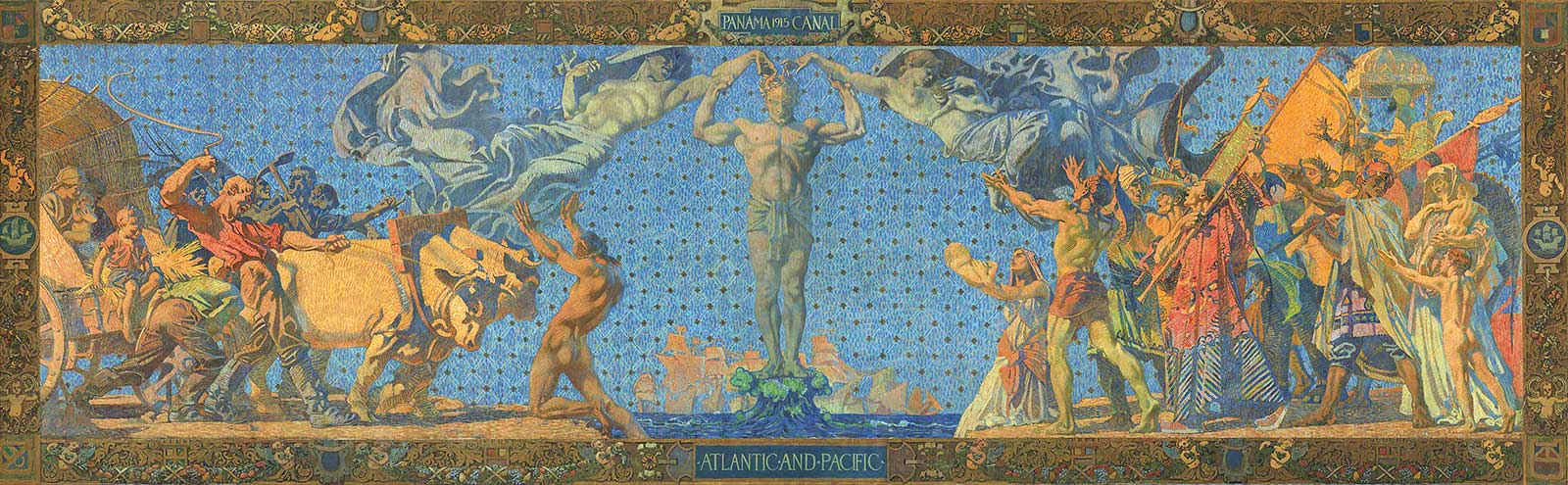 William de Leftwich Dodge (1867-1935), Atlantic and Pacific (center panel), 1914. Oil on canvas, without decorative borders: 146 x 559½ in.
Image courtesy of de Young Museum, San Francisco.
Effusive, and exhausting the lexicon of superlatives to describe the fantastic exposition, Redman continued, “It is the vivid realization of vague dreams. A dim city, with towers of ruby, amethyst and emerald wrapped in mist, or a city of the flashing white of sunshine and the glitter of gilt domes, softened by the fog that rolls in from the sea. Surely this is the land of illusions, and yet it is real.” A 435-foot-high Tower of Jewels was decorated with 135,000 suspended pieces of cut and mirrored Czech glass, which caught the sun in a glittering display of color, sparkling against the bright skies of floodlit night, when wonderful lightshows transformed the sky and buildings into ethereal visions of wonderland.
Opening day saw 200,000 attendees and nearly 19 million people visited during the course of the year. In The Innocent Fair, a 1961 documentary film remembering the exposition with clips from an archive of silver nitrate film shot in 1915, narrator Walter Johnson recalled, “It was the most wonderful thing that ever happened to San Francisco.”
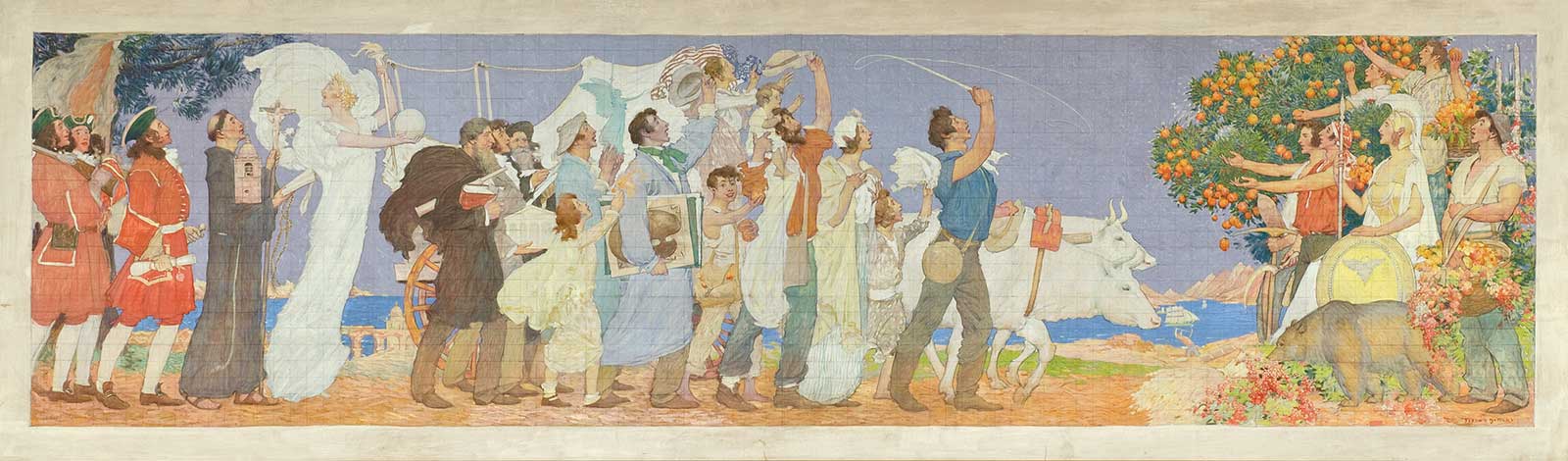 Frank DuMond (1865-1951), Study for The Westward March of Civilization: Arrival in the West, 1913. Oil on canvas, squared in pencil, 32 x 100 in.
The fair’s magnificent buildings, more palaces than pavilions, were themed as celebrations of American accomplishments in fine arts, education, social economy, liberal arts, manufacturing, industry, machinery, transportation, agriculture, agriculture (food products), livestock, horticulture, mines and metallurgy. Henry Ford showed a complete automobile assembly line. Newly invented infant incubators were demonstrated in use, saving the lives of newborns beneath the gaze of an enthusiastic audience. A stunt pilot flew loop-the-loops at night, with flares attached to the wings of the plane before losing his life in a fiery crash. Elaborate displays showing the achievements of all the states thrust home the idea of American excellence and success. Horses and cars raced for extravagant purses. But the art was the star.
Nine artists were chosen to paint for the great palaces: Childe Hassam, Charles Holloway, Arthur Mathews, Robert Reid, Milton Bancroft, Edward Simmons, Frank DuMond and William de Leftwich Dodge, all of whom were American. The organizers made a single exception for Welshman Frank Brangwyn, the prolific muralist and art nouveau éminence. The official guidebook to the fair declared him “the world’s greatest genius in color.” American artist Jules Guérin, the art director of the exposition, thought Brangwyn’s work was so important that he traveled to his London studio to admire the eight colossal canvases he produced, exploring the theme of the four elements.
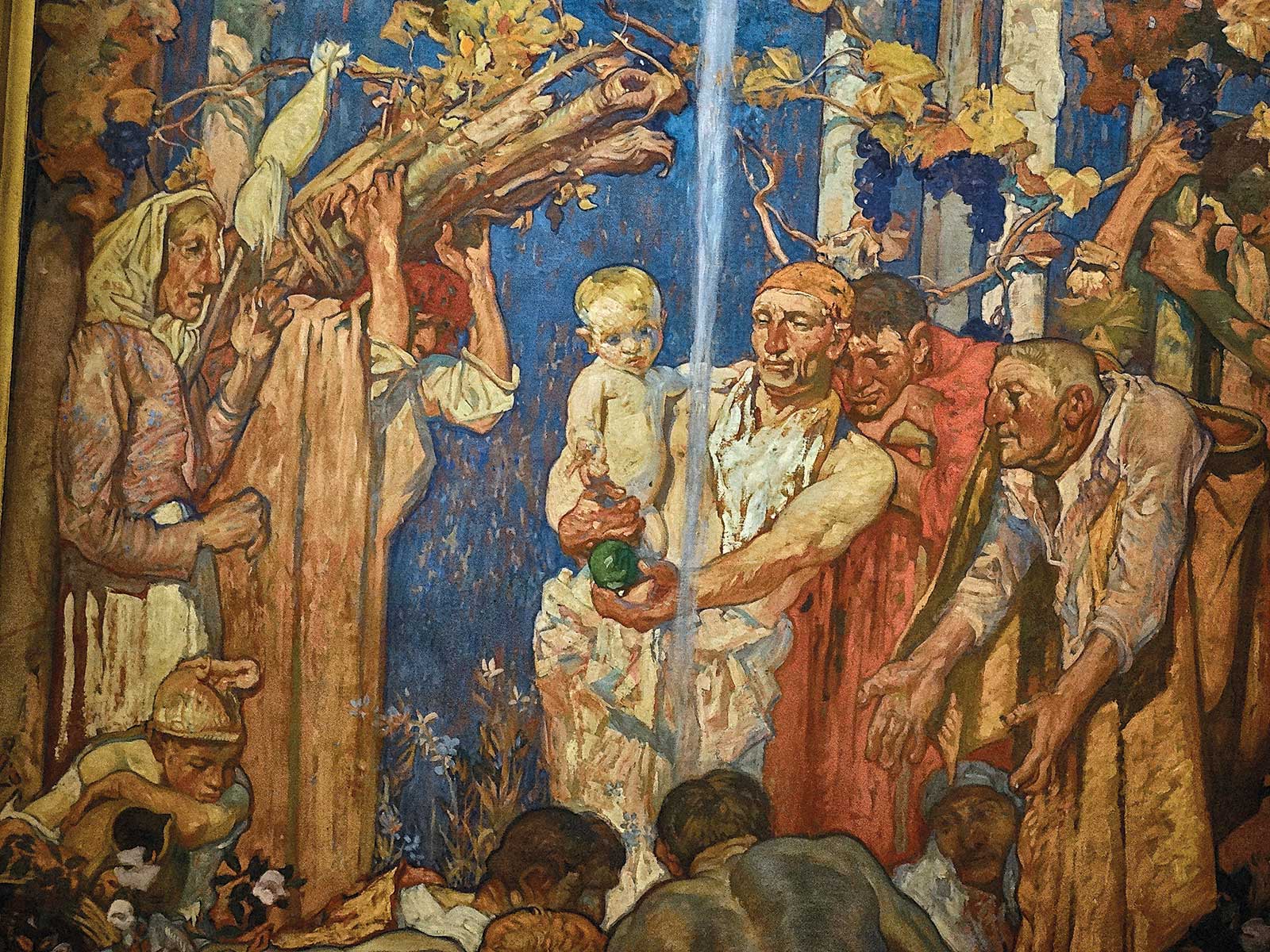 Frank Brangwyn (1867-1956), The Four Elements Fire I – Primitive Fire, Exhibited at the court of Abundance, Panama-Pacific Exposition.
Courtesy of the Herbst Theatre at the San Francisco War Memorial and The Master’s Light Photography.
Brangwyn’s paintings were loaded with crowds of figures and exaggerated the profusion of nature’s abundance, but there was little of the artificial posturing of mannerism. Brangwyn used the vertical canvases to compose great, dramatic images that explored the burdens and benefits of labor. They were the dominant decorative feature of the lavish Court of Abundance, a Moorish-Gothic architectural fantasy dominated by a tall tower overlooking a formal garden enclosed by long arcades.
Two 22-feet-wide roundels completed the Court of Palms. Hassam’s was a rigid, formulaic decoration which did little to show off his skill as a loose master of impressionist light. (His achievements were on full display in a post-exposition exhibit in the Palace of Fine Art in a showing of more than 100 of his paintings and drawings.) Holloway’s The Pursuit of Pleasure was a lovely composition of fluid figures in sensual and light work.
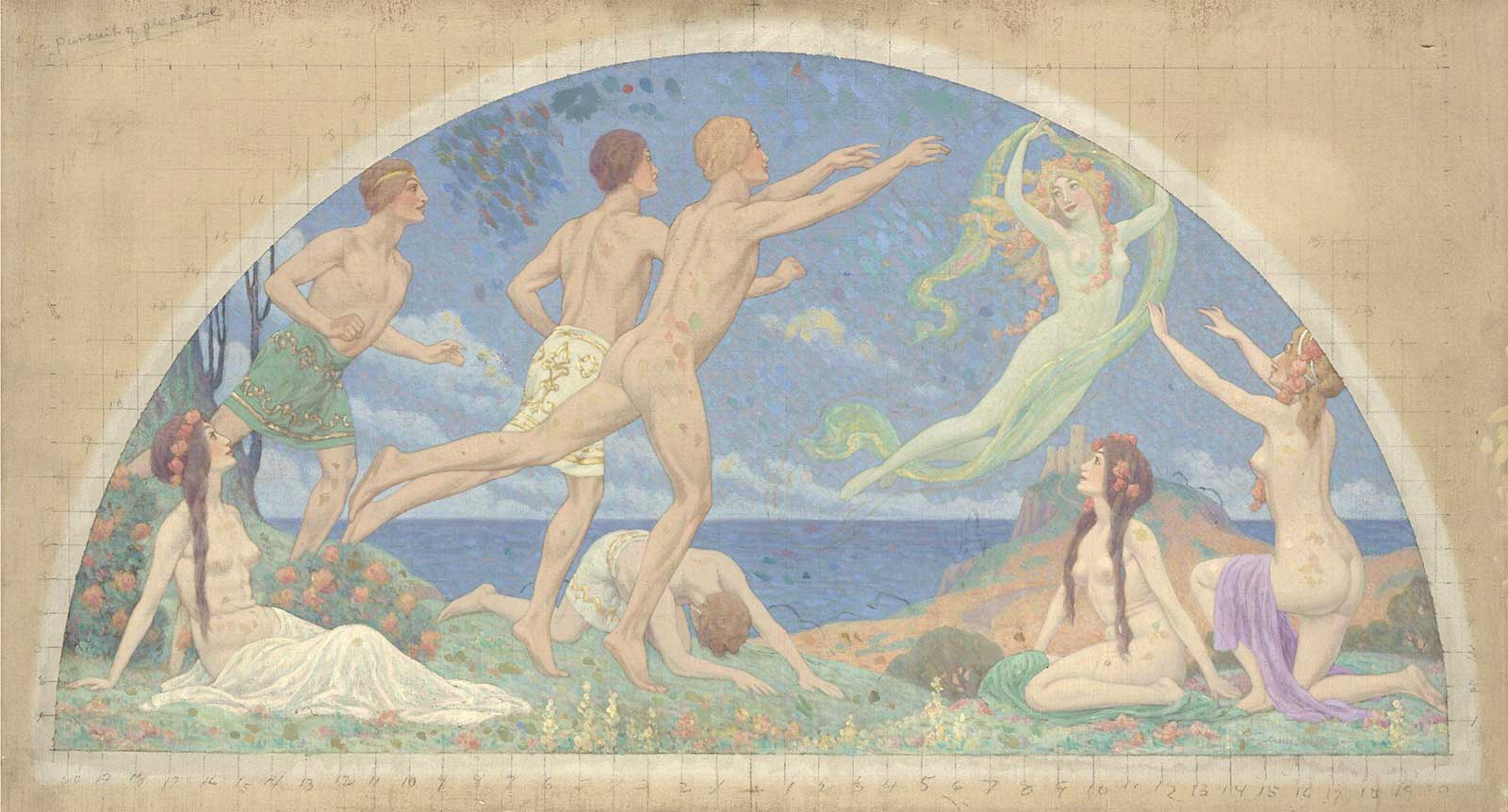 Charles Holloway (1859-1941), Study for The Pursuit of Pleasure, 1913. Oil on canvas, for transfer in graphite, 201/8 x 40 in.
The dreamy Palace of Fine Art was certainly the most popular architectural achievement of the festival. A lagoon—all that remained of the reclaimed swamp—separated it from the rest of the exposition, lending it an aura of distinguished exclusivity. Beside the water, the great dome of a rotunda supported by eight lesser domes was the centerpiece to 1,000 feet of glorious curving arcade wrapping the palace. Carefully placed trees and bushes sheltered sandy paths and cast dancing shadows onto the warm travertine of this architectural fantasia, which provided the scenography for settings of romantic dances by white-clad, flower-scattering maidens and the arrival of burly heroes in boats. The arched ceiling of the dome was decorated with beautifully curvaceous baroque spectacles by Reid, two depicting the birth of European and Oriental art, and two of art’s inspiration and idealism. Historic photos show Reid working on these vast sentimental images of beautiful women personifying art, wreathed in garlands of flowers. These were alternated with the “four golds of California”—wheat, metal, citrus fruit and poppies. Inside the Palace, a lavish series of 117 galleries contained an exhibition of international art so great that Redman wrote, “…it would take the average visitor, working 12 hours a day, 30 days to cover the pictures.” It was “the most comprehensive exhibition of American art in the country’s history.”
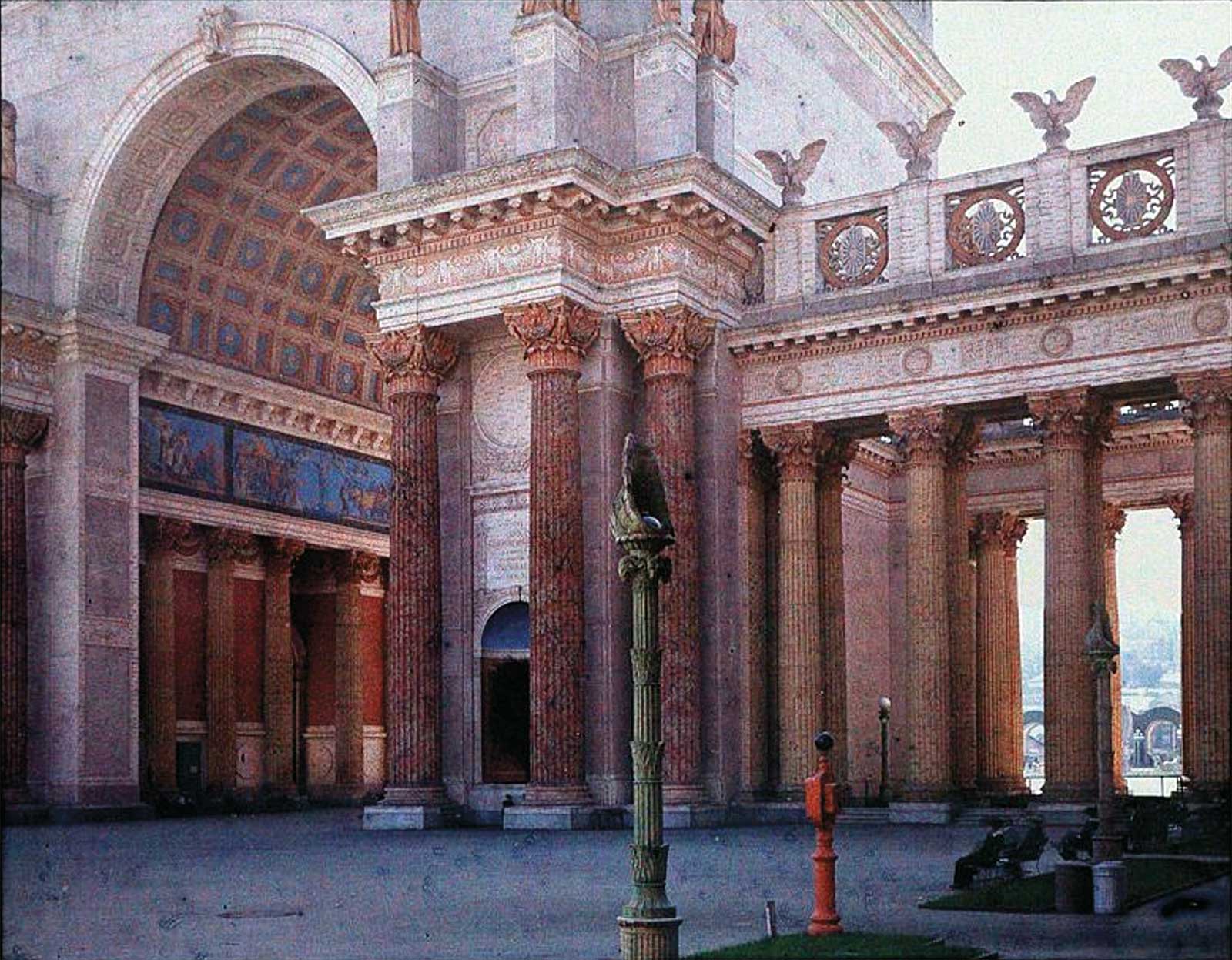 Interior of the Tower of Jewels showing William de Leftwich Dodge’s Atlantic and Pacific mural beneath the arch. Autochrome image courtesy of Pryor Dodge.
Bancroft painted 10 murals decorating the ends of high passageways in the colonnade of the Italianate Court of Four Seasons: Festivity, Winter, Harvest, Summer, Fruition, Autumn, Seed Time and Spring. The two largest, Art Crowned by Time, and Man Receiving Instruction in Nature’s Laws were directly below the beginning of the span of the grand central arch.
Simmons’ immense panels for the triumphal arch were graceful mixtures of the renaissance revival’s neo-classical figuration with celebratory American history painting, surpassed only by the spectacular symmetry of Dodge’s vast Atlantic and Pacific, which now fills a lobby wall in San Francisco’s de Young Museum, celebrating the triumphant meeting of East and West when the two oceans were joined by the Panama Canal. DuMond’s The Westward March of Civilization, now in the city’s Asian Art Museum, rejoiced in anthem-singing representative figures of the arts, science and religion, from Greece, Egypt, Europe—and Atlantis—meeting on the Pacific coast. Both painters featured whip-cracking ox-drivers, the tractor-men of pre-mechanical farming.
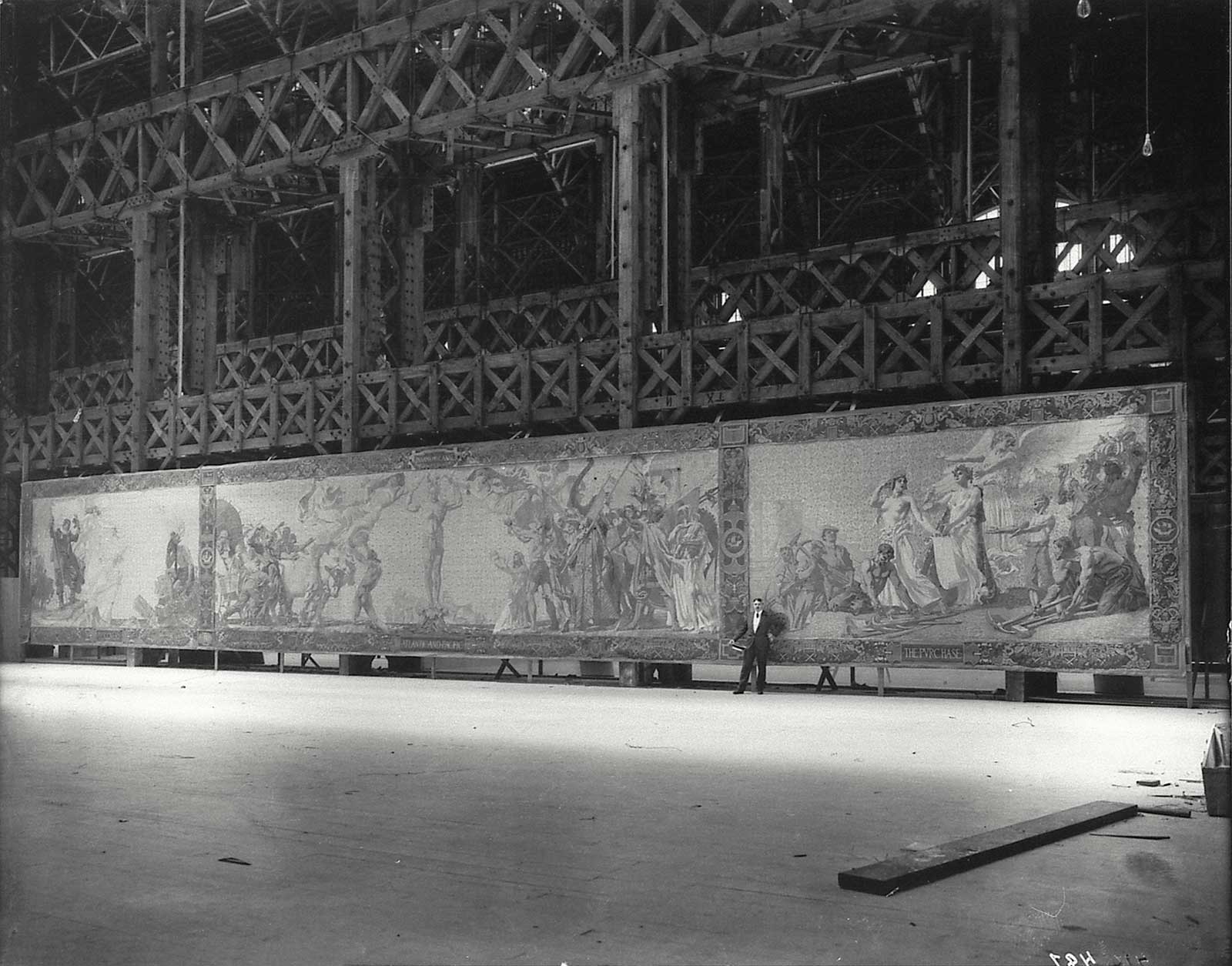 William de Leftwich Dodge at work on Atlantic and Pacific. Image courtesy of Pryor Dodge.
Besides the great achievements of the fair’s palaces, murals decorated the national and states’ pavilions. Brangwyn’s student Edward Trumbull distinguished the Pennsylvania Building with his Penn’s Treaty with the Indians, and The Steelworkers. The Netherlands Pavilion was graced with Hermann Rosse’s The Arts of Peace. A pioneering woman among the field of male muralists, Florence Lundborg painted the glory and summer of The Riches of California, spanning the interior of the California Pavilion, a harvest scene of nature’s bounty topped with an inscription from Theocritus reading, “All breathes the scent of the opulent summer, the season of fruits.”
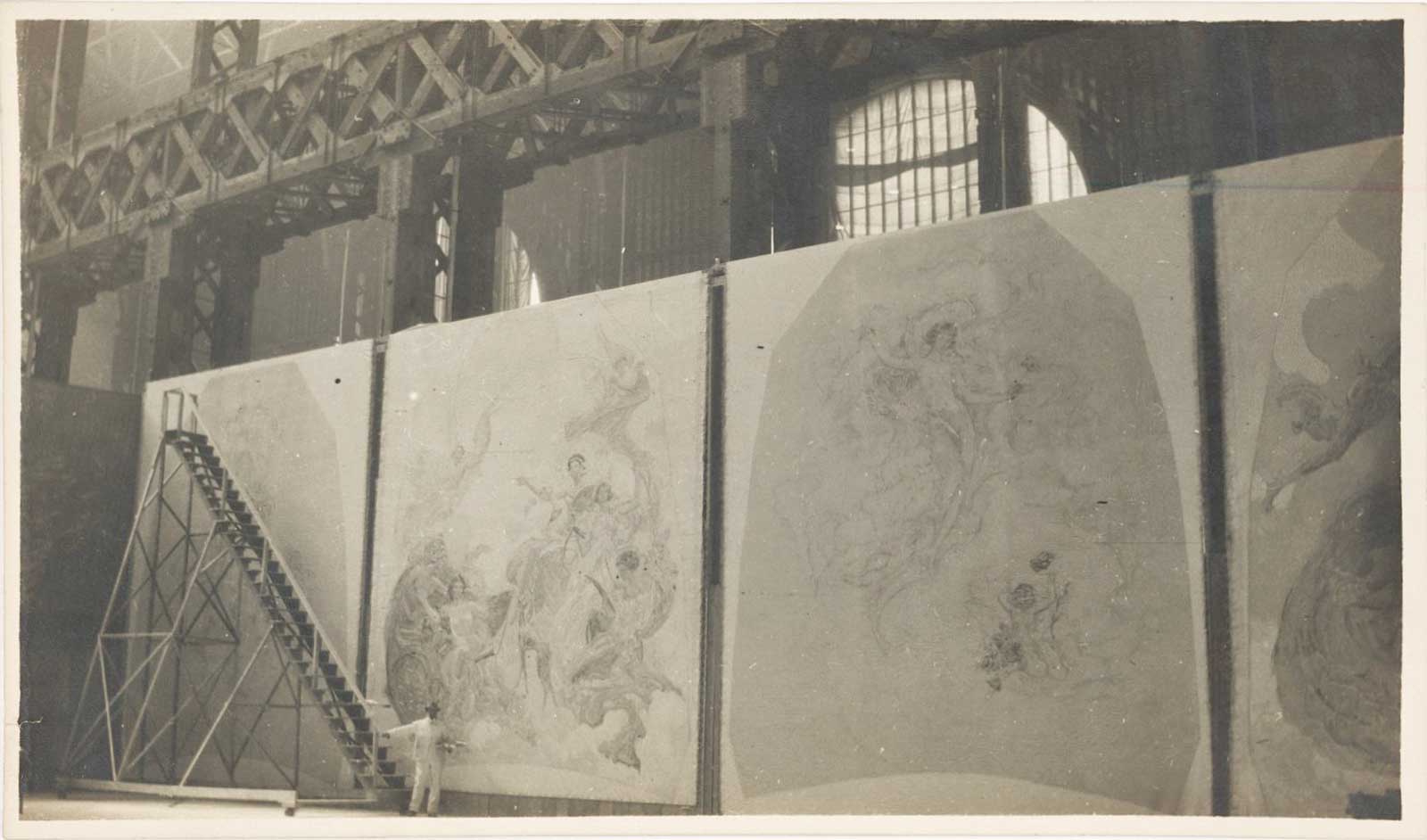 Robert Reid standing in front of a mural, ca. 1900. Robert Reid papers, ca. 1880-ca. 1930. Archives of American Art, Smithsonian Institution.
The city of San Francisco possesses the Hassam and Mathews murals but keeps them in storage and they have not been seen for a century. Brangwyn’s murals are the glory of the Herbst Theatre at the San Francisco War Memorial. Bancroft, Simmons and DuMond’s paintings were destroyed when the exposition was demolished. Unlike the other buildings, which were constructed in the temporary wood and plaster of theatrical sets, designed to last for only a year, the Palace of Fine Arts was constructed in steel and concrete to safeguard the lavish collection of paintings, etchings and sculptures from the perils of fire—still a freshly horrific memory to the citizens of the brave city. It was so beautiful that it was preserved after the close of the event, then completely rebuilt between 1964 and 1974, largely thanks to the inspiration of Johnson’s nostalgic documentary which showed it in an abandoned state of ruined disintegration. Sadly, Reid’s wonderful paintings were lost to the elements as the Palace decayed. The haunted decoration and shell of the building remains on its original site in the San Francisco marina, where the ghastly functional interior is now used as a sterile performance venue and coldly austere convention hall. Treasure was lost forever when the murals were destroyed—but the memory of these glorious paintings lived on in the hearts of the millions who saw them. John Walter, President of the San Francisco Art Association, wrote, “The Exposition had literally created tens and thousands of lovers and students of art.”
Powered by Froala Editor